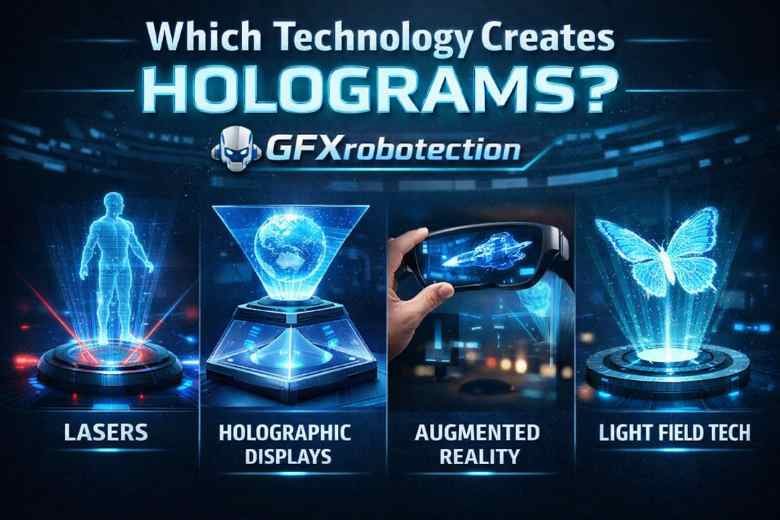
Holograms are no longer just something we see in sci-fi movies. Today, they’re being used in real-world applications like robotics, security, education, and advanced visualization. If you’re wondering which technology creates holograms gfxrobotection systems rely on, the answer isn’t a single invention. Instead, it’s a smart mix of modern display technology, computing power, and light-based science.
Rather than relying on one technique, gfxrobotection-style systems combine several technologies to create realistic, interactive 3D visuals that look as if they exist in the real world, powered by advanced visualization systems.
What Is a Hologram?
A hologram is a three-dimensional visual created by carefully controlling how light behaves. Unlike a flat image on a screen, a hologram has real depth. As you move around it, the view changes, making the image feel more lifelike.
This depth comes from recording and recreating light waves themselves, not just displaying pixels like a normal screen does.
Which Technology Creates Holograms Gfxrobotection Uses?
The technology behind holograms in gfxrobotection systems is best described as a hybrid approach. It brings together optical science, digital graphics, and intelligent software to achieve the desired result.
So the key technologies involved include laser holography, augmented reality, mixed reality, volumetric displays, and advanced computer graphics. Each one plays a different role depending on how realistic, interactive, or portable the hologram needs to be.
Laser Holography: The Foundation of True Holograms
Laser holography is the original and most scientifically pure form of hologram technology. It uses laser light to record interference patterns that contain detailed depth information. When these patterns are illuminated correctly, they recreate a full three-dimensional image.
In gfxrobotection environments, laser holography is often used for tasks that require extreme precision, such as engineering models or security simulations. While highly accurate, it usually needs controlled lighting conditions and specialized equipment.
Augmented Reality and Hologram Creation
Augmented Reality, commonly known as AR, is one of the most popular ways hologram-like visuals are created today. AR places digital 3D objects into the real world using screens or smart glasses.
Devices like Microsoft HoloLens can display interactive holograms that stay anchored in space as users move around. This makes AR especially useful in gfxrobotection systems for robotics control, training programs, and real-time data visualization.
Mixed Reality: More Interaction, More Control
Mixed Reality takes AR a step further by allowing digital holograms to interact with physical objects. A hologram can appear to sit on a table, hide behind a wall, or respond to hand gestures.
For gfxrobotection applications, mixed reality is ideal in environments where humans and robots work side by side. It allows operators to view robotic systems, safety zones, and data layers all at once in a way that feels natural and intuitive.
Volumetric Displays: Holograms Without Headsets
Volumetric display technology creates 3D images that can be seen from different angles without the need for headsets or glasses. These systems project light into a physical space, making the image appear solid and shared.
This type of hologram is commonly used in exhibitions, research labs, and high-security environments where multiple people need to view the same hologram at the same time.
The Role of Graphics Software and AI
Every hologram relies on powerful software working behind the scenes. Advanced computer graphics handle realistic lighting, shadows, and movement, while artificial intelligence and sensors track user motion and changes in the environment.
Similar visualization and intelligence-driven techniques are also transforming interactive digital entertainment, where emerging technologies are changing how users experience realism and responsiveness in games and simulations.
Meanwhile, In gfxrobotection systems, this software layer is what makes holograms practical, responsive, and safe for real-world use.
Where These Hologram Technologies Are Used
Hologram technology is now used across a wide range of industries. Robotics teams use holograms for simulation and system control. Security professionals rely on them to visualize threats and restricted areas. Engineers and educators use holograms to better understand complex machines and concepts.
FAQs: Which Technology Creates Holograms Gfxrobotection
Is laser holography still used today?
Yes, but mainly in specialized environments. Most modern systems rely more on AR and mixed reality solutions.
Are AR holograms real holograms?
They are digital, hologram-like visuals. While they aren’t laser-based holograms, they are highly practical and effective.
Do gfxrobotection holograms require special hardware?
Some systems use headsets, while others rely on volumetric displays or projection-based setups.
Can holograms interact with robots?
Yes. Many systems allow real-time interaction between holograms and robotic platforms.
Are holograms safe for users?
Modern hologram systems are designed to meet safety and light-exposure standards.
Will holograms replace traditional screens?
In industries like robotics, security, and training, they already are in many cases.
