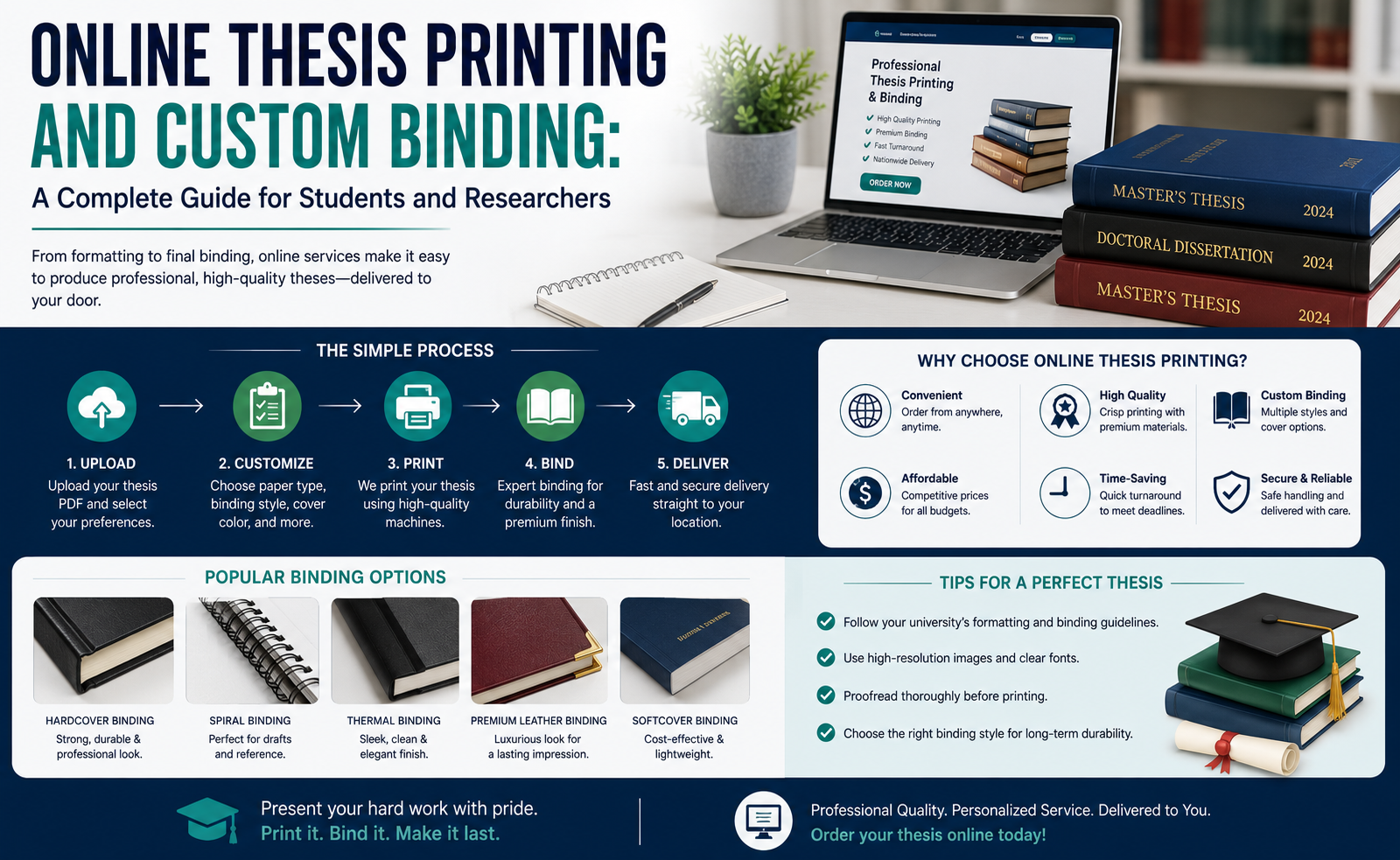
Completing a thesis is a major academic achievement. After months or even years of research, writing, editing, and reviewing, the final document deserves a professional presentation. While digital submissions are common at universities, many students and researchers still need printed copies for supervisors, examiners, libraries, presentations, or personal records. Online thesis printing and custom binding provide a convenient way to turn a completed digital manuscript into a polished academic document.
With online printing services, students can upload their thesis files, choose printing specifications, select a suitable binding style, and have the finished copies delivered to their preferred location. This approach can save time and provide greater control over the final appearance of an important academic document.
What Is Online Thesis Printing?
Online thesis printing is a service that allows students and researchers to order printed copies of their academic work through a website or digital ordering platform. Instead of visiting a traditional print shop, customers can upload their thesis electronically and provide instructions for printing.
Depending on the service, customers may be able to select:
- Black-and-white or color printing
- Single-sided or double-sided pages
- Different paper weights and finishes
- Cover materials
- Binding styles
- Number of copies
- Custom cover designs
- Delivery options
The digital ordering process is particularly useful for students who are working under tight submission deadlines or who need multiple copies for different academic purposes.
Why Professional Thesis Printing Matters
A thesis represents substantial academic effort. Although the research and writing are the most important elements, presentation also matters. A professionally printed thesis is easier to handle, read, store, and present.
High-quality printing can make diagrams, charts, photographs, tables, and other visual elements easier to understand. Properly selected paper and printing settings can also prevent issues such as ink showing through pages or important graphics appearing unclear.
Professional printing is especially valuable when a university requires physical copies. Instead of dealing with formatting problems at the last minute, students can have their documents professionally produced according to their requirements.
Understanding Custom Thesis Binding
Printing is only one part of producing a finished thesis. Binding holds the pages together and gives the document a durable, professional structure.
Custom thesis binding allows students to select a binding method based on their university’s requirements, personal preferences, budget, and intended use.
Common binding options include:
Hardcover Binding
Hardcover binding is often considered one of the most formal options for academic documents. A rigid cover protects the pages and gives the thesis a durable finish.
Students may choose customized cover colors, lettering, and other details. Some services also offer foil lettering or embossed text for a more traditional academic appearance.
Hardcover binding is particularly suitable for final archival copies or theses that will be kept for many years.
Softcover Binding
Softcover binding provides a professional appearance while generally being lighter and more flexible than hardcover binding. It can be a practical choice when several copies are required.
Softcover options may also be suitable for students who need affordable copies for supervisors, colleagues, or presentations.
Spiral Binding
Spiral binding is convenient when a thesis needs to remain open on a desk. The pages can turn easily, making this style useful for working copies or documents that require frequent reference.
However, spiral binding may not meet the formal requirements of every university, so students should check their institution’s guidelines before selecting it for final submission.
Comb Binding
Comb binding is another practical option for academic documents. It allows pages to be turned easily and can be economical for large documents.
Like spiral binding, it is generally more suitable for working or review copies unless specifically accepted by the institution.
Thermal Binding
Thermal binding uses adhesive and heat to secure the pages inside a cover. It can create a clean, book-like appearance and is often suitable for professional academic documents.
The finished result is neat and relatively compact, making it a useful alternative to traditional binding methods.
Choosing the Right Paper
Paper selection can have a noticeable effect on the quality of a printed thesis. Standard office paper may be sufficient for some projects, but higher-quality paper can create a more refined final product.
When choosing paper, consider:
- Weight: Heavier paper can feel more substantial and reduce show-through.
- Brightness: Bright white paper can improve readability.
- Finish: Matte paper is often useful for text-heavy academic documents.
- Color: White is generally preferred for formal thesis submissions.
- Compatibility: The paper should work well with the selected printing process.
If the thesis contains many photographs, charts, or colored graphics, discussing paper options with the printing provider can help achieve better results.
Color Printing vs. Black-and-White Printing
Not every thesis needs to be printed entirely in color. Black-and-white printing is often sufficient for documents that primarily contain text and simple diagrams.
However, color printing can be important when the research includes:
- Maps
- Scientific figures
- Photographs
- Data visualizations
- Graphs using different colors
- Technical illustrations
One practical solution is to print the majority of the thesis in black and white while using color for selected pages, if the printing service supports mixed-color printing. This can help control costs without compromising important visual information.
Preparing a Thesis File for Printing
Before uploading a thesis for online printing, the document should be carefully checked. Printing a file that contains formatting errors can result in costly reprints and unnecessary delays.
A final pre-printing review should include:
Check Page Size
Make sure the document uses the page size required by the university or institution. A thesis prepared in the wrong format may need to be reformatted before printing.
Review Margins
Binding can affect the inner margin of a document. Make sure there is sufficient space near the binding edge so that text, page numbers, or figures do not become difficult to read.
Check Page Numbers
Review the entire document to make sure page numbers appear correctly and consistently. Pay particular attention to introductory pages, appendices, and section breaks.
Inspect Images and Graphics
Low-resolution images can look acceptable on a computer screen but appear blurry when printed. Use high-quality graphics whenever possible.
Check Fonts
Embedded or standard fonts can help prevent unexpected formatting changes during printing. Converting the final document to PDF is often a good way to preserve its layout.
Review the PDF
Before uploading the final file, open the PDF and inspect every section. Check headings, tables, references, footnotes, figures, captions, and blank pages.
How Online Thesis Printing Works
The process is generally straightforward.
Step 1: Finalize the Thesis
Complete proofreading, formatting, references, citations, tables, figures, and appendices before sending the document for printing.
Step 2: Create a Print-Ready File
Save the final version as a PDF when possible. This helps preserve the intended layout and reduces compatibility problems.
Step 3: Select Printing Specifications
Choose paper type, printing method, page orientation, color settings, and the number of copies required.
Step 4: Choose a Binding Style
Select hardcover, softcover, spiral, thermal, or another available binding option according to your requirements.
Step 5: Customize the Cover
If available, add details such as the thesis title, author’s name, university, department, degree, and submission year.
Step 6: Review the Order
Carefully verify the page count, number of copies, binding style, cover details, and delivery information.
Step 7: Place the Order
Upload the final file and complete the order through the online printing platform.
Step 8: Receive and Inspect the Finished Thesis
Once the thesis arrives, inspect the binding, pages, cover, images, and overall print quality before submitting it.
Benefits of Ordering Thesis Printing Online
Online printing offers several advantages over handling the entire process manually.
Convenience
Students can place an order from home, university, or anywhere with an internet connection. There is no need to repeatedly visit a physical print shop.
Greater Customization
Online services often provide several combinations of paper, printing, cover, and binding options. This makes it easier to create a thesis that meets specific requirements.
Time Savings
The ability to upload a completed document and order copies online can simplify the final stages of thesis preparation.
Consistent Quality
Professional printing equipment can produce more consistent text, graphics, and cover finishes than basic home printers.
Multiple Copies
Students can order several copies at once for supervisors, examiners, university departments, family members, or personal archives.
What to Consider When Choosing a Thesis Printing Service
Not every printing provider offers the same level of quality. Before placing an order, consider several factors.
First, check whether the company has experience with academic documents. Thesis printing often involves large page counts and specific formatting requirements.
Next, review the available binding options. A provider with multiple binding styles can give you greater flexibility.
Turnaround time is also important. If you have a submission deadline, confirm the estimated production and delivery time before ordering.
It is also worth checking whether the company offers a proofing or preview option. Being able to review the order before final production can help identify errors.
Finally, compare pricing carefully. The cheapest option is not always the best choice when the document represents years of academic work.
Common Mistakes to Avoid
Several simple mistakes can cause problems during thesis printing.
One common mistake is ordering before checking university requirements. Some institutions specify exact dimensions, binding types, cover colors, or lettering requirements.
Another mistake is failing to check the final PDF. A missing page, incorrect figure, or formatting error can become much more difficult to correct after printing.
Students should also avoid leaving printing until the last possible moment. Unexpected technical problems, production delays, or delivery issues can create unnecessary stress.
It is also important to order the correct number of copies. Consider who needs a physical copy and whether you want an additional copy for your personal records.
The Value of a Professionally Bound Thesis
A thesis is more than a collection of printed pages. It is a permanent record of research, analysis, and academic achievement. A well-produced document can be easier to handle, protect, store, and reference over time.
For students completing undergraduate dissertations, master’s theses, or doctoral research, professional printing and binding can provide an appropriate final presentation for their work.
Final Thoughts
Online thesis printing and custom binding make the final stage of academic work more convenient and flexible. From selecting paper and printing options to choosing a customized binding style, students can create a finished document that reflects the importance of their research.
The key is to prepare the file carefully, understand institutional requirements, choose appropriate materials, and allow enough time for production and delivery. With the right printing service, a completed digital thesis can be transformed into a durable, professional academic document ready for submission, presentation, or long-term preservation.
